IOV operates in the northern region of the state of Mato Grosso, known as the “Portal da Amazônia,” located at the center of the so-called “Arc of Deforestation.” This region is characterized by the strong presence of family farming, which, despite the expansion of large-scale landholdings, still accounts for approximately 80% of rural properties.
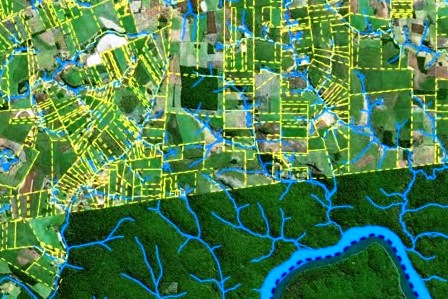
Since the 1970s, the region has faced intense pressure from deforestation, initially driven by logging and the establishment of perennial crops. Over time, other predatory activities became predominant, including gold mining in the 1980s, extensive cattle ranching from the 1990s onward, and more recently, large-scale soybean production.
This land-use model, based on monoculture, intensive mechanization, and the use of agrochemicals, has led to significant environmental impacts, such as landscape fragmentation, reduced connectivity between forest areas, and declining environmental quality. It has also contributed to increased fire occurrence, greater incidence of agricultural pests, and reduced opportunities for income generation based on forest resources.
From a social perspective, this process has contributed to land concentration and rural outmigration, particularly among young people, thereby reducing the productive capacity of family farming households.
In response to these challenges, IOV, throughout its trajectory, including with support from the Amazon Fund in previous projects, has contributed to the development of sustainable alternatives in the region. Key advances include the implementation of diversified production systems, such as agroforestry and silvopastoral systems; improved communication infrastructure within communities; the strengthening of networks of family farming organizations; accumulated experience with microcredit; the consolidation of research networks; and increased engagement with public technical assistance services, particularly in initiatives focused on sustainable production systems.
THE PROJECT
The current project represents the third phase of the “Sementes do Portal” initiative. It will engage 800 producer families (2,400 individuals), who will benefit from at least one direct support action across 12 municipalities in the state of Mato Grosso: Alta Floresta, Carlinda, Colíder, Cotriguaçu, Guarantã do Norte, Matupá, Nova Canaã do Norte, Nova Guarita, Nova Santa Helena, Novo Mundo, Peixoto de Azevedo, and Terra Nova do Norte.
The initiative aims to enhance environmental and social benefits through agroforestry and silvopastoral systems focused on generating income for families; to promote local value addition by strengthening four key value chains with strong regional potential; to implement planned restoration in ecological corridors in order to avoid landscape fragmentation; and to strengthen community microcredit mechanisms. All activities are integrated, supported by technical assistance and rural extension services, and informed by applied research based on challenges and hypotheses identified by the producers themselves.
The project is structured around four main components:
Component 1 (Strengthening Value Chains) focuses on supporting four value chains that rely on agroforestry and silvopastoral systems as the foundation of their income-generation strategies, fruit production, seed production, dairy farming, and community-based tourism. Activities include technical assistance to community-based productive organizations and farmers, training events and knowledge exchange, institutional strengthening, and support for expanding agroforestry and/or silvopastoral areas.
Component 2 (Improving Environmental Quality) aims to restore strategic areas to ensure connectivity and the development of ecological corridors, contributing to regional biodiversity and landscape transformation. This component includes the restoration of 2,000 hectares of permanent preservation areas (including springs and riparian forests) and Legal Reservesconsidered strategic for settlements and rural communities involved in the project, using agroforestry systems. It also includes the development of a monitoring system for restoration areas and other project investments, as well as training activities on planting and managing agroforestry systems for restoration.
Component 3 (Expanding the Agroforestry Research Network) seeks to improve knowledge on ecosystem services provided by native species in order to develop or refine nature-based solutions that strengthen family farming livelihoods. Research activities are linked to all project components and include studies related to microcredit management, such as improving monitoring indicators. This component also includes support for experimental silvopastoral systems, the renovation of IOV facilities, and the implementation of a technological innovation award.
Component 4 (Technical Assistance and Microcredit Strengthening) provides technical advisory support to family farming initiatives, both in agroecological production and microcredit promotion. It also includes financial support to the Raiz Community Bank, enabling investment in priority value chains and restoration areas. Activities include strengthening the community bank, building a network of agroecology agents, supporting meetings and exchanges, and producing publications and communication materials.
The main expected results include:
- Restoration of 2,000 hectares of permanent preservation areas and legal reserves, and 1,150 hectares managed under agroecological practices linked to fruit production, dairy farming, forest seeds, and community-based tourism;
- Three structured community-based productive organizations with increased revenue from agroforestry products and regional differentiation strategies (brands and/or certification labels);
- 800 families (2,400 individuals) benefiting from at least one direct project investment;
- 720 producers benefiting from capacity-building activities (training workshops, exchanges, regional congress participation, research events, and activities related to supported value chains and microcredit);
- Support to 80 families through microcredit initiatives over four years, reaching a total of R$800,000 in loans funded by the Amazon Fund by the end of the project.
INTERVENTION LOGIC
The project is aligned with Components “Sustainable Production” (1) and “Science, Innovation and Economic Instruments” (4) of the Amazon Fund Logical Framework. Its expected outcomes are consistent with the Action Plan for the Prevention and Control of Deforestation in the Legal Amazon (PPCDAm), aiming to promote sustainable productive activities, foster sustainable forest management, and support the recovery and restoration of deforested or degraded areas.
In addition, the project contributes to the improvement of economic instruments that enable the implementation of the plan’s strategic actions. These objectives are directly linked to the preservation of natural resources in the Legal Amazon.