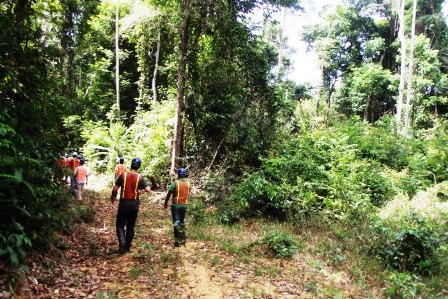
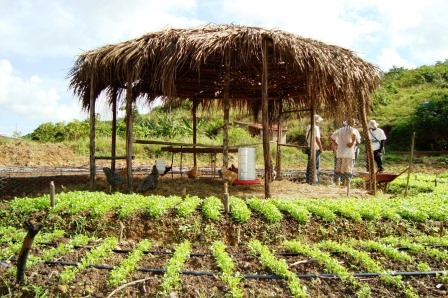
The project is structured around four components.
Its main activities are presented below.
Component 1 – Financial Mechanism for Territorial and Environmental Management
The project established a mechanism to provide direct support to Indigenous organizations for the development, updating, and implementation of territorial and environmental management instruments. The Steering Committee, composed of Cese, the Coordination of Indigenous Organizations of the Brazilian Amazon (Coiab), the Articulation of Indigenous Peoples of Brazil (APIB), the Podáali Fund, and invited specialists, was responsible for selecting proposals through public calls and monitoring the supported initiatives.
The first call for proposals, launched during the 2024 Free Land Camp (Acampamento Terra Livre), supported 28 Indigenous organizations under the Urucum and Jenipapo categories. To broaden participation, virtual guidance and information sessions were held, resulting in the submission of 74 proposals. The selected initiatives included activities such as the development of free, prior and informed consultation protocols, environmental assessments, ethnomapping, territorial monitoring, training of Indigenous fire brigades, strengthening of productive activities, and increased participation of women and youth in community decision-making processes.
Cese conducted quarterly virtual monitoring meetings and field visits to eight projects in the states of Amazonas, Tocantins, Mato Grosso, Pará, and Roraima, supporting the implementation of activities and the administrative and financial monitoring of the initiatives.
A second call for proposals was also carried out, drawing on lessons learned from the previous cycle and incorporating improvements in application criteria, guidance to participating organizations, and project design processes. A total of 45 proposals were received from eight states in the Legal Amazon. Following technical and documentary review, 25 Indigenous organizations were approved for contracting: 19 under the Urucum category, focused on the implementation of Territorial and Environmental Management Plans (PGTAs), and six under the Jenipapo category, aimed at the development, updating, or completion of territorial and environmental management instruments.
According to information reported as of May 30, 2026, the project had supported the implementation of territorial and environmental management instruments in 44 Indigenous Lands, covering 40.1 million hectares and directly benefiting 8,807 Indigenous people, including 3,917 women.
Component 2 – Technical, Managerial, and Legal Support
To strengthen the management capacity of the Indigenous organizations supported by the project, a Partnership Network was established, bringing together organizations with experience working alongside Indigenous peoples in the Amazon. The network provides technical, managerial, and legal assistance to organizations selected through the calls for proposals, contributing both to the implementation of supported initiatives and to the strengthening of territorial and environmental governance.
Twenty-four organizations were contracted to support the implementation of projects selected under the first call for proposals. At the same time, coordination efforts were undertaken to establish the network associated with the second call, resulting in the nomination of 19 organizations that will provide support to the newly selected initiatives.
Component 3 – Capacity Building
Training activities included workshops, meetings, and guidance sessions aimed at strengthening project management and preparing the Indigenous organizations selected through the project’s calls for proposals. In 2024, activities focused on project planning, development, and management, fostering knowledge exchange and enhancing the capacity of Indigenous organizations in environmental, administrative, and financial management.
In 2026, activities focused on preparing the Indigenous organizations selected under the second call for proposals. A virtual workshop was held to provide guidance on contractual procedures, involving CESE’s legal, project management, financial, and communications teams, as well as 51 representatives of Indigenous organizations.
Component 4 – Strategic Communication
The project continued implementing its communication strategy, which includes the participation of COIAB’s Indigenous Communicators Network in producing articles, graphic materials, reports, photographs, videos, and other content related to project activities. The network comprises approximately 200 communicators active throughout the Amazon region.
The second training program for Coiab’s Indigenous Communicators Network was conducted through two virtual sessions and one in-person phase. The first virtual session, attended by 53 participants, addressed the current context of socio-environmental rights, focusing on issues relevant to the National Policy for Territorial and Environmental Management of Indigenous Lands (PNGATI), such as the legal framework protecting Indigenous Lands, the temporal framework thesis, land invasions, deforestation, and infrastructure projects that affect Indigenous autonomy and ways of life. The second session focused on social media strategies and was attended by 60 participants.
The in-person phase took place from March 31 to April 2, 2026, bringing together 40 representatives from 17 Indigenous organizations across six Amazonian states. The agenda covered a range of topics, with emphasis on the challenges of journalistic coverage in Indigenous territories and practical training in text production.
The project website remained regularly updated with news articles, feature stories, photographs, and testimonials from supported organizations. News releases, social media content, institutional publications, videos, and educational animations were produced and disseminated. Highlights included the launch of the publication Dabucury: First Experiences (link to repository in portuguese), the update of the Project Management Guide (link to guide in portuguese), the production of the final episodes of the project management web series, and content presented at events such as COP30 and the 2026 Free Land Camp (ATL).