Versão em Português
Project

Sustainable Northern Corridor

Institute of Agriculture and Forest Management and Certification (Imaflora)

Código do projeto: 4662287
Project official website
Total project value
R$ 3,310,210.47
Total support amount
US$ 1,359,987.87
organization type
Third Sector
Themes
Settlement
Location
Pará
Axises
Sustainable production
Concluded

Presentation

Objective

Strengthen family extractive and agricultural activities as vectors to develop the Northern Corridor in the state of Pará by implementing food processing units and seedling nurseries for agroforestry systems (SAFs) in quilombola communities and settlements

Beneficiary

34 quilombola communities and one settlement in the region

Territorial scope

Municipalities of Oriximiná and Alenquer, in the state of Pará

Description

Project selected in the first Amazon Fund’s direct public call-to-submission of sustainable production projects.

CONTEXTUALIZATION

The Northern Corridor encompasses around 27 million hectares and occupies 22% of the state of Pará, covering the largest set of protected areas (conservation units, Indigenous lands, and Quilombola lands) of tropical forests on the planet, with approximately 20 million hectares. Added to the protected areas of Amapá and Amazonas, it makes up the largest biodiversity corridor in the world.

Quilombola communities and Indigenous populations are located along the Trombetas River. The main economic activities of the Quilombola communities of Oriximiná are extractivism (with emphasis on Brazil nuts) and agriculture. However, they face difficulties selling the nuts independently, depending on regatões and other intermediaries, which drastically reduces the margin received per sale. To change this scenario, Imaflora had already been working to promote the development of the commercialization chain together with these populations, and this project aimed to strengthen this activity in the region.

With the residents of the Paraíso Sustainable Development Project (PDS) settlement, the institute began work aimed at institutionally strengthening the local association, as well as activities aimed at raising awareness and training these actors in sustainable agricultural practices.


THE PROJECT

The project aimed to strengthen extractivism and family farming as drivers of development in the Calha Norte region of Pará, through the establishment of food processing units, a seedling nursery for Agroforestry Systems (SAFs), and a community carpentry facility in quilombola communities and settlement areas.

The project was structured by supporting subprojects implemented by local associations. The following actions stand out:

• Construction, structuring, and implementation of four food processing units (UBAs) in quilombola communities in the municipality of Oriximiná to foster access to institutional markets.
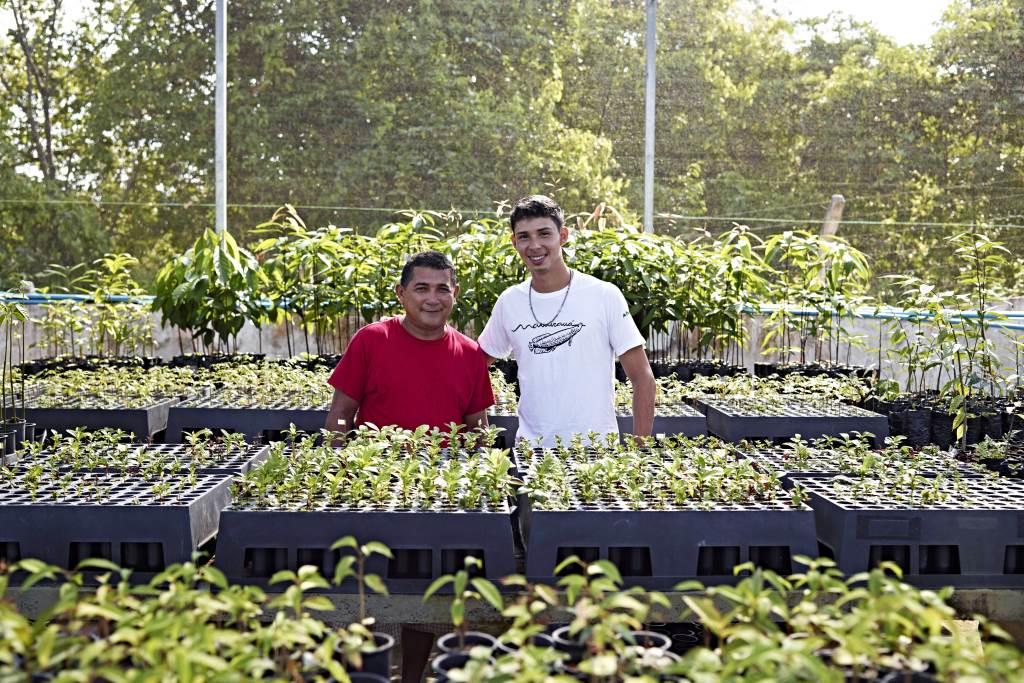
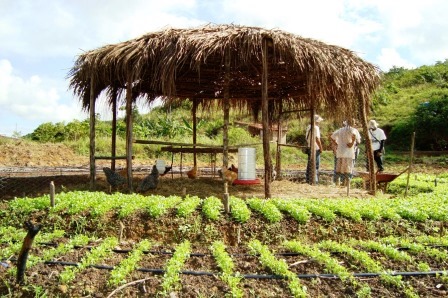
• Construction and structuring of a nursery for seedling production aimed at the implementation of Agroforestry Systems and forest restoration in the Sustainable Development Project (PDS) Paraíso, in the municipality of Alenquer.
• Construction of a community storage and primary processing facility, complemented by two additional interventions focused on providing local technical assistance and project management support.


INTERVENTION LOGIC

The project was included in the “Sustainable Production” component (1) of the Amazon Fund’s Logical Framework.

Its direct effects were defined as “agroforestry product chains with increased added value in the municipality of Oriximiná (PA)”; “expanded managerial and technical capabilities for the processing of agroforestry products, implementation of nurseries, and community management in the municipalities of Oriximiná and Alenquer (PA)”; and “deforested and degraded areas recovered and used for economic and ecological conservation purposes by SAFs”.


Click on the following image to view its objectives tree, that is, how the project's outputs and linked to the expected outcomes and impact.

quadrologico_EN


Evolution

Date of approval 08.26.2014
Date of the contract 10.29.2014
Date of conclusion 11.28.2023
*Disbursement period 05.29.2021
*Deadline for disbursements
approval
08.26.2014
award
10.29.2014
conclusion
11.28.2023

Disbursement

date amount
1º disbursements 12.22.2014 R$352,261.50
2º disbursements 01.13.2016 R$1,102,105.51
3º disbursements 01.12.2017 R$1,045,676.15
4º disbursements 12.26.2017 R$568,983.69
5º disbursements 04.29.2021 R$243,850.15
6º disbursements 10.16.2023 -R$2,666.53
Total amount disbursed R$3,310,210.47

Total amount disbursed in relation to the Amazon Fund’s support

100%

ACTIVITIES CONDUCTED

The activities carried out are divided into subprojects, as follows:

1 – Food Processing Units (UBAs)

Subproject 1 aimed to construct, structure, and implement four food processing units in quilombola communities in the municipality of Oriximiná.

To achieve this, the following activities were carried out:
(i) preparation and execution of the construction plan for the facilities;
(ii) licensing of construction works and obtaining sanitary authorizations;
(iii) acquisition, delivery, and installation of equipment and utensils to support the sweets and baked goods value chains;
(iv) development of the business model and business plan for the UBAs;
(v) training in minimum food processing and UBA management; and
(vi) support for the operation and management of the UBAs.

2 – Community Nursery

Subproject 2 aimed to construct and structure a nursery for seedling production to support the implementation of Agroforestry Systems (SAFs) and forest restoration in the Sustainable Development Project (PDS) Paraíso, located in the municipality of Alenquer.

The activities carried out included:
(i) preparation and execution of the construction project for the nursery;
(ii) acquisition of a tractor and equipment required for nursery operations;
(iii) establishment of the seedling production area;
(iv) training in seedling production, seed collection, and nursery management; and
(v) development of the Nursery Business Model.

3 – Community Storage and Primary Processing Facility

Subproject 3 focused on the construction and structuring of a community facility for storage, primary processing, and commercialization of extractive products, promoting multiple‑use non‑timber forest management and income generation in quilombola communities of Oriximiná.

Activities under this subproject included:
(i) acquisition, delivery, and installation of machines and equipment, including one electric seed breaker and two generators;
(ii) preparation of a warehouse to serve as the operational base for the community facility, which will also function as the administrative headquarters of the enterprise; and
(iii) discussions on the business model and operational arrangements for the enterprise.




Final Evaluation

Result and Impact indicators

The project’s activities contributed to the results related to the “Sustainable Production” (1) component of the Amazon Fund Logical Framework.

Below are the results of the main indicators agreed upon for monitoring the expected direct effects.

Direct Effect 1 – Agroforestry product value chains with increased added value in the municipality of Oriximiná (PA)

  • Revenue obtained from the economic activity for sustainable use supported by the project (stratified by type of product)
    Target: no predetermined target | Result achieved: R$ 4,058,193.01
  • Revenue obtained from the economic activity for sustainable use supported by the project exclusively generated by commercialization via government purchases or subsidies (stratified by type of product)
    Target: no predetermined target | Result achieved: R$ 476,388.00
  • Number of individuals directly benefiting from activities supported by the project
    Target: no predetermined target | Result achieved: 2,145
  • Number of women directly benefiting from the activities supported by the project
    Target: no predetermined target | Result achieved: 724
  • Number of settlers directly benefiting from activities supported by the project
    Target: no predetermined target | Result achieved: 873
  • Number of individuals trained to process agroforestry products and establish nurseries and community management by effectively using the acquired knowledge (specified by gender)
    Target: no predetermined target | Result achieved: 203
  • Number of individuals participating in awareness-raising or integration events
    Target: no predetermined target | Result achieved: 1,150

Product 1.1 – Construction of food processing units (in natura products)

  • Construction and implementation of four agro‑processing units to enable value addition and improve market access for products destined for quilombola school feeding programs
    Target: 4 | Result achieved: 4

It is worth noting that agroindustries began supplying food for quilombola school meals in Oriximiná via the National School Feeding Program (PNAE).

Product 1.2 – Implementation of a community storage facility

  • Number of community storage facilities constructed
    Target: 1 | Result achieved: 1

Direct Effect 2 – Expanded managerial and technical capacities for agroforestry product processing, nursery implementation, and community management in Oriximiná and Alenquer (PA)

  • Number of individuals trained in basic food processing and community management
    Target: 80 | Result achieved: 251
  • Number of individuals trained in seed collection, seedling production, and nursery operation
    Target: 40 | Result achieved: 6

This number was lower than expected due to delays and setbacks, especially during the initial phase of implementation of this subproject due to the need to solve inconsistencies in the limits of PDS Paraíso in the database of the National Institute for Colonization and Agrarian Reform (Incra).

Direct Effect 3 – Deforested and degraded areas restored and used for economic and ecological conservation purposes through agroforestry systems (SAFs)

  • Construction and implementation of a seedling nursery to ensure autonomy in seedling production and enable scaling up the implementation of agroforestry systems and restoration of degraded areas, accompanied by the development of a business model for the PDS Paraíso nursery
    Target: 1 | Result achieved: 1

Equipment such as a New Holland TT 4030 wheeled agricultural tractor was also acquired, which has been widely used for implementations, particularly for new noburn swidden farming systems, a low-impact production system promoted by Imaflora. Additionally, brush cutters, irrigation systems, kinetic seed crackers for forest seeds, generators, among others, were acquired

Institutional and administrative aspects

With regard to the project management component, Imaflora carried out the activities necessary to ensure the proper progress of the project, including coordination with the BNDES and participating partner organizations, as well as the financial reporting of project expenditures.

Technical assistance activities, in turn, provided support for the actions carried out under the other components of the project.

Risks and lessons learned

During the implementation of the project, difficulties were encountered in carrying out its activities, which resulted in delays relative to the initial schedule. Nevertheless, Imaflora made significant efforts to present alternatives and solutions to fulfill the project’s objectives, submitting proposals for resource reallocation and developing complementary activities using funds external to the Amazon Fund.

Thus, despite the delays and setbacks, it became evident that the project succeeded in achieving its purpose of strengthening extractivism and family farming as drivers of development in the Calha Norte region of Pará.

Sustainability of results

The activities carried out through the subprojects (four agro‑processing units, a seedling production nursery, and a community storage and primary processing facility) have contributed and will continue to contribute to adding value to the production of the communities benefiting from the project and to expanding opportunities for the commercialization of their products.

The interest shown by association members in producing seedlings for commercialization has led Imaflora to seek consultants, using its own resources, to provide guidance on the requirements for certifying the nursery under the National Registry of Seeds and Seedlings (RENASEM), revising the Association’s bylaws, and developing a business plan to identify the seedling species with the greatest market potential in the local context.

Because the PDS area has an excellent degree of conservation of its native vegetation, combined with the nursery activity, it will be possible to develop or integrate the Association into a seed network, thereby mobilizing seed collectors of native species in the territory and generating a new business opportunity. The consultant’s role will be important in supporting the organization of this seed network.

The warehouse of the community storage facility has been functioning as a meeting space and a venue for internal activities of the Quilombo do Jauari Mixed Cooperative (COOQUILOMBO), which is preparing to assume its operating costs, as well as for the Jauari community.


Collection

In this area we offer some PDF files with the main publications generated by the project. Click the filename to start the download.