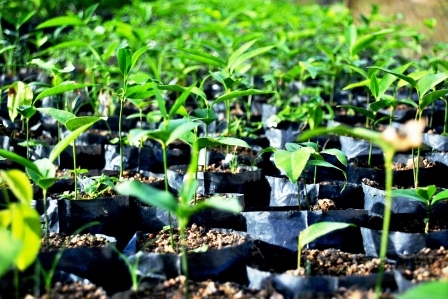
With regard to environmental regularization, investments were made in inputs, equipment, and maintenance of two nurseries for seedling production to be distributed to family farmers within the scope of the project.
To directly support the environmental regularization of rural properties, each municipality had an extension technician responsible for visiting properties and providing guidance on environmental legislation and agricultural production, analyzing the Rural Environmental Registry (CAR) of the properties, preparing the Degraded Areas Recovery Project (RAD), and carrying out technical assistance activities under the Plantar Project with producers.
The process followed by Rioterra for CAR analysis and RAD preparation generally consisted of: (i) carrying out mobilization activities and selecting rural properties to be regularized; (ii) conducting registration, diagnosis, and document collection; (iii) submitting the data and information to the Plantar Project's Geographic Database; (iv) analyzing the CAR using satellite imagery from various years and field data to map and validate areas with environmental liabilities; and (v) validating the information with field technicians and preparing the forest restoration project in accordance with the model and criteria required by the Environmental Regularization Coordination of the State Secretariat for Environmental Development of Rondônia (SEDAM/COMRAR).
Several structural and modernization works were carried out in the nurseries located in Itapuã do Oeste and Rolim de Moura, resulting in expanded production capacity. In addition, interventions were carried out at the Itapuã nursery: construction of a 275 m² warehouse, construction of a 145 m² administrative building, paving of 600 m² with concrete blocks, and construction of shade houses (3,025 m²). In Rolim de Moura, a 150 m² warehouse and a 42 m² office were built, and access areas for loading and unloading were improved with 600 m² of concrete block paving.
It is also important to highlight the selection of 20 properties, totaling 37.31 hectares, located in seven municipalities in the central region of the state, for the establishment of “technology showcases”- cocoa‑producing properties with ideal conditions for obtaining high‑quality beans with high added market value. These properties were equipped with irrigation systems, fermentation boxes, technical assistance and rural extension support, and solar dryers or drying structures. As a positive outcome, one of the assisted families won the award for best cocoa in Rondônia during the 3rd edition of the Rondônia Cocoa Quality and Sustainability Contest (Concacau).
In the component related to rural extension services for family farming, families received technical assistance, and several meetings were held to implement, strengthen, and support associative groups and activities aimed at promoting participatory management in the implementation of the PRA under the Plantar Project.
Regarding capacity‑building for family farmers, 33 training activities were conducted during project implementation, including 21 courses, 4 exchange visits, and 8 field days, totaling 352 hours of training with 536 participants (329 men and 207 women), focusing on reforestation, environmental regularization, and sustainable production.
Advisory actions for social organizations aimed to clarify and guide administrative, financial, and personnel management issues, fostering institutional and productive development in supported communities. They also helped inform decision‑making regarding the importance of regularizing members' properties as a means of maintaining compliance and environmental legality. Over the course of the project, 194 hours of advisory support were provided, and 120 social organizations participated in associative groups.
Materials were also produced to disseminate the project's actions to the general public, some of which supported efforts to attract new beneficiaries and provided planting guidance.
In landscape monitoring and analysis, studies were conducted on physical‑environment relationships to identify the natural fertility of areas through soil sampling and laboratory analysis. These data were essential for guiding field technicians involved in rural extension and RAD preparation, enabling the selection of the most appropriate crops for each environment, thereby increasing planting success rates. Soil analyses also made it possible to assess physical characteristics to identify environmentally fragile areas and prioritize restoration. This information was consolidated in the report “Analysis of the Physical Environment in the Plantar Project Area.”
For monitoring and evaluating areas under restoration, with the purpose of mapping and tracking natural and altered vegetation cover and generating information (image maps) around degraded areas undergoing restoration in small rural properties in participating municipalities, an online platform was developed containing geographic data - Sigweb. The platform displays the geographic locations and information of the two nurseries and serviced rural properties, as well as restored polygons and other interactive layers such as protected areas, roads, and drainage networks.
For monitoring and evaluating carbon absorption dynamics, a geospatial database (GEODATABASE) was developed to consolidate carbon studies related to environmental restoration activities in assisted rural properties. This database was developed by the research team of the Rioterra Study Center (CES) together with partners from the Federal University of Paraná (UFPR) and the Federal University of Rondônia (UNIR). It contains monitoring data for studies quantifying carbon stock absorption in soil, biomass, and necromass within areas undergoing restoration using direct planting or natural regeneration.
Training sessions related to the PRA were carried out to present technicians with: (i) the environmental regularization flow of the state of Rondônia; (ii) the system for preparing RADs; and (iii) the techniques for monitoring areas under restoration. The target audience included Rioterra technicians, partner institutions supporting environmental restoration projects, and technicians from public agencies involved in the environmental regularization system.
To disseminate scientific and pedagogical knowledge, six scientific, educational, or informational publications were produced.
For the structuring of the laboratory at Rioterra’s headquarters (geoprocessing lab), furniture was acquired and electrical improvements were made to prepare the space for the required equipment and machinery.